
Are You Going My Way?
Revisiting a 2023 survey on operating as artist publishers.

I found a draft of an old post that I never quite completed—I thought I’d dust it off and finally put it out into the world as an interlude between more technical articles. This shares out the results and responses to a survey on small press arts publishing that was distributed almost 3 years ago.
There is also a second, tangential essay embedded into this one: footnote no. 5—which documents the beginnings of a quest for missing provenance on a quotation near and dear to the small press community (for those interested in that sort of adventure).
As I’m easing my way back into my own publishing practice, I’ve been picking up some of the projects that have been slumbering. Usually these are in the form of folders or clipboards of notes + sketches + manuscripts + test prints (I like to work on projects in the analogue as long as possible)—but one such endeavor, recently unearthed, lives as a bookmark, a recording, a survey, and a spreadsheet.

I’m going to introduce the project a little more in the rest of this article, but the short version of things is: This is a survey I wrote a few years ago to figure out what resources might be helpful for people getting started in artist publishing—it asks you about your own early experiences in the field and how you make things work now. I’m reviving this research as it’s full of questions I’m still asking, and I’d love to hear your perspective if you have time to spare. The survey takes about 20 minutes to complete, and is open to anyone who makes (or is a part of the making of) zines and / or artists books!
The form itself appears to be down—so I guess this is the impetus I need to finally rewrite, simplify, and republish a new version of it!
In April 2023 I had a sort of delayed “debut” as a publisher, at the first annual Seattle Art Book Fair (SABF). It was probably the second or third fair that I tabled—and the first “art book” fair, where my vaguely academic™ work really made sense (I think I had been at Short Run Comix Festival the preceding fall, where my little research guides were tucked beyond the comics and things I had helped other friends publish). But it was sort of a soft debut, I had been making books here and there for the past few years, and had quit my design job just before the pandemic hit. And I was (slowly) becoming more involved in the local risograph and small press communities.1
The previous year, the organizers of SABF (Jayme Yen + Tom Eykemans) held a virtual fest called Makeready and I pitched a conversation / panel for the fair—around the point at which projects become books.
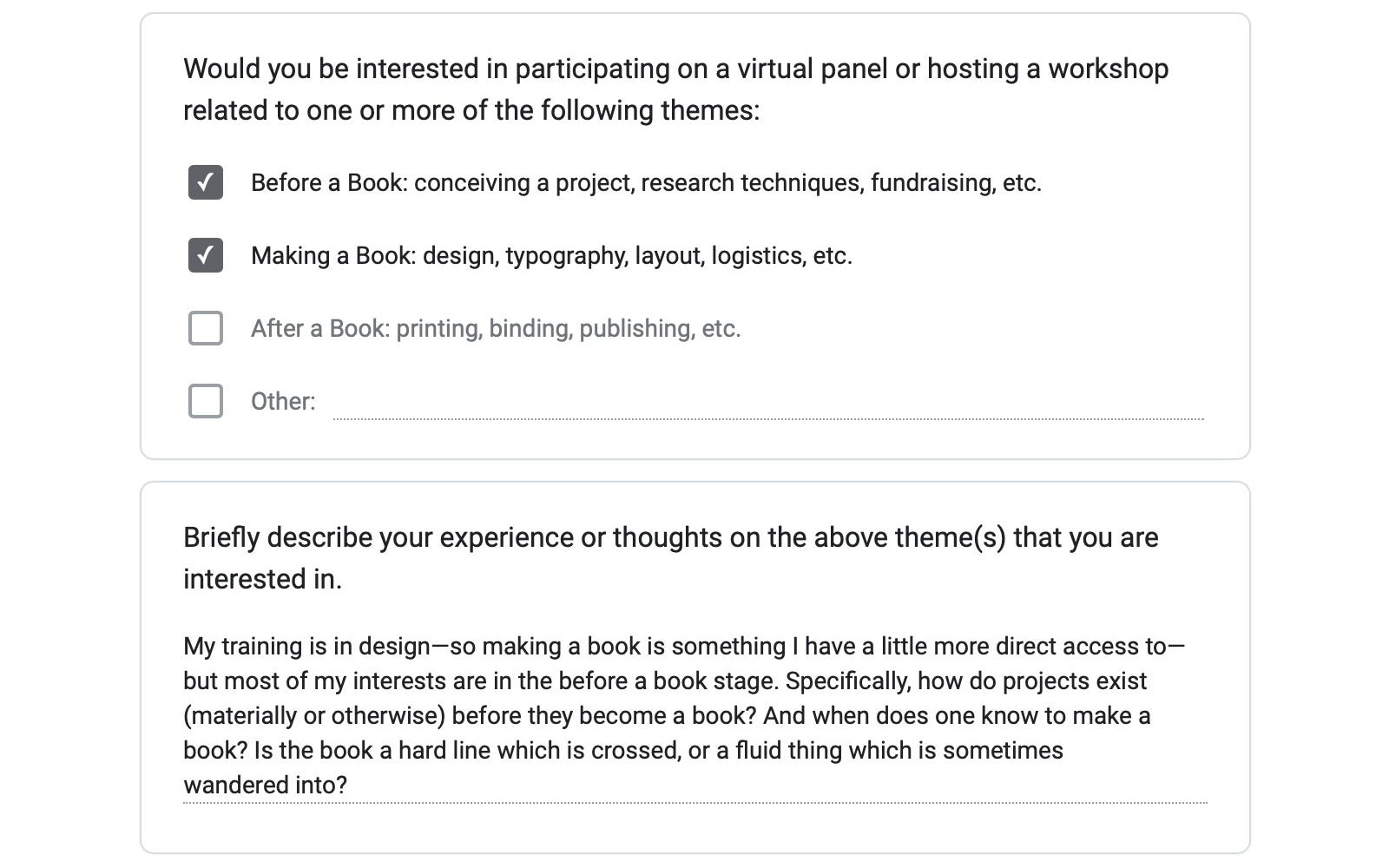
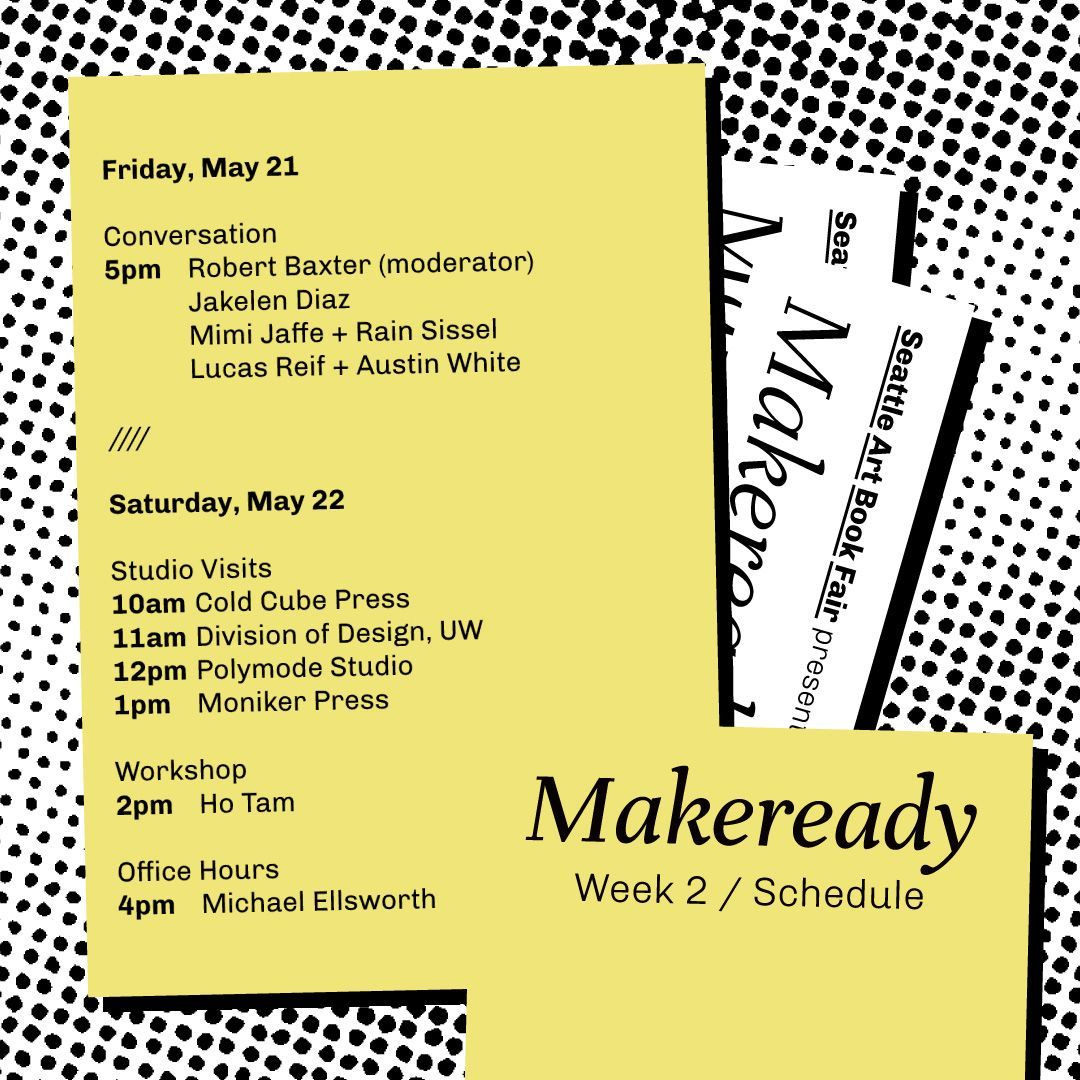
The panel went great—I enjoyed curating it and interviewing everyone beforehand, figuring out questions and throughlines, etc.—and it was well received. Tom and Jayme and invited me to run something else at the first in person version of the fair.
Again, I hadn’t really tabled much at the time (or “published” much in the structured sense of the term) and was just testing the waters of arts organizing. I was getting oriented—navigating how all this worked and who I wanted to be as a publisher. So the big question I had for other people was:2
I wanted to know:
What role do you play in this ecosystem and how did you find that spot?
What were you doing before you got into arts publishing?
Who (or what) helped you get here?
How does this balance with the other things you do in your life? And how do you make it work financially?
What was the first arts publishing project you worked on, and how did it inform your current practice?
What dreams do you have for people who are just getting started in artist publishing? What do you want this little world to looks like?
At this point the project diverged into two paths:
A public 𝗦𝗨𝗥𝗩𝗘𝗬 asking a bunch of this stuff—which I sent around through my channels and to friends and contacts in small press land. I really like writing surveys, but I definitely went overboard in this case—the finished thing is 37 questions (mostly multiple choice) and takes about 20 minutes to complete. It asks all of the above things, and breaks them down to their minutiae.
The form remains active, though outside of the first push it only moves very slowly.When it was sent out originally, 16 people responded—but I’ve kept it alive as something to talk about and pass around. And it’s gathered a few more responses in that time. I’m very interested in revisiting this work, especially as my own perspective on artist publishing has developed over time—this post is a little revival effort to gather some more info and perhaps find something to publish / share from this research in the future.A community 𝗣𝗔𝗡𝗘𝗟 for the fair, to act as a little platform for discussing all these things as a small group. I invited three panelists, who each had very different origins in small press:
Alex Barsky, of animation duo and comics publisher Zine Hug (with her partner, Zack Lydon).
Futureman, who runs the comix press Neoglyphic Media and the Bellingham Alternative Library.
Colleen Louise Barry, who I knew through her work as Mount Analogue, an incredible book store and performance space in Seattle (2016–2019).
We gathered in a little circle of about 25 people in the classroom of the fair, and had a really good conversation—with everyone asking each other questions and answers coming from both the panelists and the attendees.3
(Preliminary) Findings
The sample size so far is quite small, so I can’t say too much quantitatively—but there were some patterns starting to emerge, and there was a lot of cool qualitative stuff that came up as well. Here’s a little listing of some of the initial things taking shape, and quotes from the participants (anonymized).
IDENTITY
Universally, people in small press wear many hats.
Folks were given a long checkbox list of roles they play in this world (artist, writer, editor, publisher, printer, etc.)—most people selected six or more different roles. The most common was artist which almost everyone identified as (the other two had selected writer and editor).
People in arts publishing are doing lots of things outside of arts publishing.
Only one person said publishing was the only work they do. About a third said they had a day job in the arts, and another third said they had a day job that wasn’t in the arts (and many people were doing a bunch of little things). A bunch of respondents also checked a box that said “it’s all connected (somehow)” which I included because it’s how I think about my own practice—all the bits and pieces relate to and build upon each other.
HOW WE GOT STARTED
About half the group got their start in classic zine culture (fanzines, DIY, etc.). Many also started in school/academia. A smaller number came from other arts-related fields, production work, archiving, and distribution/bookstores.
“I was operating an arts-focused punk library from the living room of the house where I lived.”
“I was doing some drawing before but then started going to this screen print workshop in my hometown and I started to work hand in hand with the master printer there.”
“I have always been scrappy. Then and now. I have worked in service industry/gig work most of my life and felt most attuned to my scrappy dog lifestyle when working gigs and being around other gig working artists. I felt most removed from what I wanted working in galleries, where I basically gave up on making my own work.”
“I was a comics nerd as a kid, and when I saw my first zine, everything changed. It changed again when I saw my first Fugazi show, and then again, and again, and again (for decades). Each one of those things opened up a new community (or aspect of it) for me. It shifts and changes, but that process has never really stopped. It’s what art does.”
“I worked at Random House as a publishing assistant. I have always been an artist and a writer. I also love comics.”
“I came to bookbinding through social media, specifically by discovering fanbinding and ArmoredSuperHeavy's "How To Make A Book" how-to/manifesto…. In many ways, the concept of making books just for myself and as gifts freed me up substantially. When ‘you can read it! it's a book!’ is the measure of success, I felt much more free to celebrate my successes and experiment in a way that I might not have if I was holding myself to some loftier standard than ‘have fun, make book.’”
Most of our early influences are indirect books we find, artists we discover—direct human/mentor support is far less common.
Only a small portion reported having a mentor or teacher they could interact with directly in artist publishing. Further, fewer than half were involved in in-person arts communities, and only a tiny portion were part of online communities.4
FIRST PROJECTS
A good majority of us are getting started in small press as adults, not as kids.
About half of our first forays in making books/zines are a single copy—the other half are short runs (no one is starting out with long runs of a project).
The projects people described were really great—briefly they included: a cryptid zine, a magic zine, 250 pages of erotica, personal writing/drawing, a chapter of a future textbook, a rebound fantasy novel, self portrait class project, an ode to breakups, horror comics meta zine, a poetry broadside, and a Gargoyles fanzine.
Most often we’re making these first projects on our own.
The majority of the group said their first project was on their own, while a small chunk said it was with other people. And of those other collaborators, it was about an even split between those who had some small press knowledge and those who did not.
COMMUNITY
We’re split on our experiences of finding community, though by and large many of us working towards building community.
About a third of the group said they found community easily, and another third said it was difficult to find community. And less than half said that they believe artist publishing is a “generally supportive/open community.” A few participants said they still feel like they don’t have community in this field. However, the majority of people also said they try to invite others into the small press community (although perhaps this is bias from the natural inclination of people willing to fill out a survey like this).
I asked specifically about finding and making community through publishing (a la André Breton’s “one publishes to find comrades”)5 because, for me this is a huge part of why I’m involved in this world—book people are my primary community. It’s sort of the core of this survey, I want to learn how we can better support this community, and where we are missing resources/opportunity/infrastructure/culture.
There’s a wide range of ways we contribute to community, and again—we’re each doing multiple things.
Some common things mentioned: acting as a mentor/teacher, providing labor to other projects, seeking collaborators, making themselves available to newcomers. And the majority of the group also agreed that “the things [we] make are [our] contributions.”Twice as many people reported operating in local community than in broad community—but this is very dependent on where you are.
“The community where I live is not very big but we are managing to create spaces for publishers, artists and public.”
“I have some local community who also create books, but that mostly acts as a supplement to my greater online bookbinding community.”
“I think it has changed a lot over the years/ decades, but there’s always been a great community [in Minneapolis]; I always get nervous when things gets TOO insular/specialized, but it seems like there’s generally a tradition of crossover here.”
“I've found most of my community online.”
I feel like the community in Seattle is fairly disparate—but recent efforts from folks like Anemone, SABF, and Short Run have helped develop it.
“[In Detroit] trying to always make myself as a resource of information/peptalks while threading the needle of not being able to/wanting to be an open hours copy shop.”
We want two things: (1) more mentors, and (2) more financial/logistic support, knowledge, and sharing within the community.
I asked one of my own big questions directly: “What sorts of things would have helped you feel more supported as you got started in arts publishing?”—and the most commonly mentioned thing in all the write-in answers was mentors or teachers of some kind.
“Mentorship from book artists and librarians.”
“A community of people where I live, or any kind of mentor.”
“Courses, mentors, and in-person events, like book fairs and art collective meetings.”
“More availability from older craftspeople. Books on bookbinding are very expensive, and it can be hard to find someone to show you when you need help.”
“There was no internet then, so you were very much on your own and had to actively search out other people in the real world. I miss that, in some ways, though it was difficult. It took more effort, but the payoff felt deeper, more hard-won, and I wouldn’t trade it. At the same time, I am thankful for the fact that people can connect in so many other ways now, to share support/resources/etc.”
Other resources requested were centered around the money of small press, or the logistics of operating in this space:
“Transparency about financing! GenderFail has recently put out a phenomenal zine about this [Publishing Now: GenderFail’s Working-Class Guide to Making a Living off Small Publishing]. Also, resources for risographers about where to get supplies and pricing for contract jobs.”
“I think that larger conversations about money would have been a good middle step.”
“Just knowing that arts publishing was something you could do (and how to survive and grow with it). Pathways—how to get started and where to go next.”
Another excellent desire I don’t want to omit was: “spaces where to exhibit the work. That could be art book fairs or other events at a museums or public institutions.”
COLLABORATION
We’re often working both collaboratively and independently, but collaboration is a shared modality and/or aspiration.
The vast majority of respondents said they both work on their own and with others. Of those on the other said who work mostly independently, all said they wanted to do more collaborative work of some kind.“I'd say the actual production of my work is pretty independent, but the learning and skill-building and teaching aspect of making books is HIGHLY collaborative in my community.”
“I generally publish other artists’ work, however the production of the books is a very collaborative process, where I'm heavily involved in design and production aspects.”
“When the project is a book, I can collaborate as a writer, editor, copyeditor or proofreader. But I also conduct research and write papers in collaboration with peers.”
“I operate in three kinds of ways: (A) providing a service on others projects (as printer or teacher), (B) on my own projects (which are developed and edited in conversation with friends), (C) in collaboration with other artists as an editor.”
Publishers are often creating their own projects while also lending their skillsets + resources to artists less familiar with print media.
Many of the press operators who responded talked about how they both print + bind their own work and projects for/with other artists and writers. Different practices are very unique, so it seems often like a matter of finding projects which resonate with our individual ethos and capabilities—I think Rachel Hays of Taxonomy Press put this balance very succinctly when she described helping people to “reimagine the book in a way that fits my press.”
MONEY + LOGISTICS
A “short run” is below ~200 copies for most people (though for some it’s under 50 copies or less, and for others it ends at 1000).
This was asked as a broad definition, but when asked about their own production, most folks reported either making an average of 275 copies of their projects, or 25 or fewer (for those doing hand sewn bindings on artists books).About 50% of us are making little to no personal income from publishing (many reported that they are putting more money into publishing than they are getting out of it).
Over half of respondents said that if they stopped publishing, their financial needs would still be met (and many said they would be easier to meet). Meanwhile, a small contingent of the participants said that arts publishing is their primary source of income.
An overwhelming majority of us are funding our own projects.
The other main sources of funding (but even then, only a fraction compared to the self-funded work) were from other creative contributors/collaborators or sponsors/donors of some kind.
Only a quarter of us pay ourselves for our labor.
Though a larger portion pay others for their labor. Multiple wrote in to explain that they are trying to pay themselves for at least a portion of their labor, but are often unable to.
Most of our projects either generate a small income or break even.
No one said their projects generated a large income. Almost half the group said that projects made enough profit to fund the next project.
We’re an anticapitalist crowd, and navigating our small publishing work is part of how we put that in practice.
I asked a (probably overly) broad question to solicit comments on capitalism. Which revealed sort of what I expected: that as an ethos we are largely an anticapitalist group, but we also exist in an odd limbo where we are producing and selling wares. Reconciling those two things (or struggling to) is part of how we each define our practices.
“I think capitalism dramatically limits the ways we can creatively and fully engage with ourselves, our joy, and each other.”
“I'm an anti-capitalist, and try to eschew financial exchanges whenever possible to maintain production.”
“I have a lot of thoughts about the art world and its relationship to capitalism, and I think zine publishing is radical in the face of that.”
“I am anticapitalist—I think we need to develop meaningful alternatives, even if they are temporary, and actively and communally counter the systems it has created and reinforced.”
“I struggle with even pricing my publications, and asking for money on top of that is difficult for me.”
“Capitalism is such a difficult challenge for artists—to create for yourself, or for an audience is the eternal questions. I'm a firm believer of universal basic income and health care for all, which would benefit artists and marginalized populations greatly.”
“I sometimes see myself making less taxable income as harm reduction.”
“I think its ongoing pervasive effects have eroded/are in the process of destroying just about everything worth caring about on the planet.”
HOPES + WISHES + FUTURE
The last section of the survey was fully open-ended, I asked participants what they dreamed of for the small press community, what questions they’d like to ask others, and if they had any closing remarks. Since this was all just a write-in section, I’ll just share some favorite quotes.
“An environment that is more supportive of small publishing and presses which are no/low profit—and one in which teaching/mentorship happens throughout the community.”
“Further access to grants specific to small press publishing.”
“My hope is for the art publishing to be truly diverse and inclusive to all, as well as more active regarding pedagogy and social justice.”
“I would love more people to feel empowered to make the work they want to put out in the world and to continue to collaborate without competition. Stop overcharging us for table fees! Hold institutions that capitalize off our cachet/ideas/sweat equity to account. Collectively raise our prices. Stop undercharging in such a way that we screw each other over. More artist-led spaces.“
“To further embrace community and reciprocity to a degree where we can diminish the harmful effects of capitalism that weighs on artists and publishers.”
“I think the arts publishing community is more important and critical now than at any other time of my life. The stakes are higher than ever, and it’s incredibly important to continue to engage on an independent/community-based level.“
Past Happenings
This is a little look into what was going on about a year ago, when I started drafting this post. Included here because why not?
A few months ago I returned from my first trip to Europe as a risographer! I visited Pamflett + KMD in Bergen, &soWalter + Det Risografische in Stavanger, Quintal + (the newly formed) Magma in Paris, and a little German GR in the Folkets Hus in Nørrebro, Copenhagen. I got to work on (and successfully repair!) multiple A2 machines during the journey, which was a highlight, but second to all of the lovely people I got to meet and chat with.
Since returning, I ran a pair of maintenance workshops at the Icebox Project Space which were co-organized by FORTUNE and Ulises (which I finally got to visit!). I also managed to do some bonus repairs with Soapbox, StitchPrism, and the Ginger Arts Center while I was in town. The workshops went really well (probably a more refined version than I’ve been able to teach before—thanks to excellent facilitation by Connie Yu, Andra Palchick, and Tim Belknap), and they involved creation of a new resource—the Drum Safety Test Card (for GR / FR and Z+ type drums)—which I’ll put out more publicly after a little more fine tuning. Finally, the Big Summer Book Sale itself was very sweet, though I was exhausted and mostly stumbled through it in a literary stupor.
Current Happenings
There’s a little under two weeks left until I head to Berlin for the Flyleaf festival. And I hope to debut 2, maybe 3 new little zines for it! This is perhaps too ambitious but I am gonna do my best. If I pull it off, I think the next post will be a catalogue of the zines I table with these days?
Since I have been staying home to focus on publishing the past few months, my repair income has gone down a bit—so I’m doing a lot of video repair calls this week to try and fund some of my flights!
All of my books are finally off the floor, and (mostly) unboxed. And now that I have table and floor space, I think when I get back from Europe, it’ll be time to embark on a big repair project I’ve been putting off for a bit: the full restoration of an IBM Selectric. I now have two full machines—one assembled, the other which I stripped down about 50% into parts during a sort of manic and chaotic night last year. I’ve also acquired almost all of the key technician documentation for these models, a bunch of replacement parts, and some proprietary tools.
Credit here (as with so many things) to Anemone, and their work organizing both a distributed zine residency and a series of small press picnics (a potluck where you bring books too—the ”Bookluck”). Amelia and I got risos around the same time and it was her and Adam’s efforts that really drew all us stencil duplicator types together in Seattle.
This question of “how do you get started in this other thing” was one I had asked more broadly (too broadly) maybe a year earlier. I was getting started teaching design at the same time as I was becoming more and more disillusioned with the design industry. I was teaching a design history class (maybe more on this in some future post) and was getting really distressed about teaching students to be critical of the built (designed) systems of living and capital and truth—while knowing full well that the institution was jettisoning them out into a field that would require they check those values at the door.
So I had a dream of creating a guide for alternative design practice. It was the early covid era of massive shared google docs of resources—and I drafted up a skeletal one for this. The aim was to plot the paths of people who have a design education but don’t practice as “designers.” I was going to bring in collaborators to share the route they took, and advice they have for students, and then map that to resources for secondary studies and experiences they could be pursuing if they wanted to be a publisher, or paper engineer, or draftsman, or prop maker, etc.
I never got it past the proof of concept (probably because the scope was too heavy and the teaching itself was too exhausting), but the skeleton is still up and accessible here: Alternative Practice.
I have very low quality audio of this somewhere that I need to find and transcribe. I believe some friends may have taken video as well.
This was interesting to me—I had expected more online community stuff, but probably just due to my own involvement in a few of the online riso + artist book groups. But it does make sense as this is a very analog art/craft practice with its own history of print-based community-building. I think for me there is an interest in following both of these threads: (A) building out more access to and resources for online spaces, and (B) learning more about the asynchronous print pathways that introduce small press to people (I’m thinking of physical mailings, correspondence classes, resource directories, etc.).
I got stuck in a small rabbit hole here for about 2 hours, trying to determine the original source of this quote, which is now ubiquitous in small press writing. And I cannot find the actual text from André Breton. But here’s the path so far:
It seems like the popularization of this quote is due to its use in the title of Eva Weinmayr’s “One Publishes to Find Comrades” (The Visual Event, ed. Oliver Klimpel, 2014)—a great piece about the immediacy and collaboration of posters + pamphlets of journals. It speaks on how urgent printed media directly invokes and depend on collecting a readership, with the goal of connecting them in the present moment to their writers/artists/organizers, who are themselves a collective sharing authorship and ideas.
“Let us examine in more detail what happens before (and after) this moment of going public. Let us not look at publishing as the end of a process during which consolidated thoughts and enquiries are put into a final brochure, book or leaflet. Let us look at publishing more as a way to initiate a social process, a social space, where meaning is collectively established in the collaborative creation of a publication. From this perspective, all of a sudden publishing is not a document of pre-defined cognitions. Publishing becomes a tool to make discoveries.”
(I first encountered this essay in Miss Read’s Publishing Manifestos, and jotted down both the above quote and the title in my commonplace book.)
Weinmayr’s piece attributes the Breton quote (dated 1920) to Gareth Branwyn’s Jamming the Media: A Citizen’s Guide Reclaiming The Tools of Communication" (Vancouver: Chronicle Books, 1997) a sort of survey and introduction to “new media” (most other pieces which include the quote cite either Weinmayr or Branwyn). Here it’s found in the introduction to Chapter 1 “The Passion Press”:
“One publishes to find comrades! Or so declared the irascible surrealist André Breton in the 1920s. Such a statement would certainly tilt the heads of today’s commercial publishers like dogs responding to a high pitched squeal. Obviously, the mainstream publishing world strives to make money, to win awards, and to fill marketing niches. Finding new friends and revolutionary co-conspirators is unlikely to appear on a commercial publisher’s list of objectives. Breton was obviously talking about an entirely different realm of publishing.”
It then goes on to introduce zines as a form of counterculture media, along with some history, a glossary of zine types, a bit of how to (the “zine hacker’s starter kit”), and a resource list. It’s not an academic book and the quote isn’t cited directly (and no bibliography in the back, just image credits), but there are some things in the resource list that might be where Branwyn found it originally (many of them are books zines that interview other zinesters, like Zines! from V/Search Publications, Factsheet Five, Obscure Publications from Jim Romenesko; also the reflections of Pagan Kennedy in ‘Zine).
It’s a very contemporary, and strangely colloquial source for one of the big quotes in small press (it’s also broad rather than specific, the second chapter moves on from zines into underground music publishing). Our window for the date of the quote has moved from the year 1920 to the decade of the 1920s—so we’ve got a wider range to sift through if we take it back to Breton.
First though a slight detour back to Weinmayr—the quote in question is brought up again later on in the essay, this time in relationship to the writing of Stevphen Shukaitis and the piece “Toward an Insurrection of the Published? Ten Thoughts on Ticks & Comrades” (from the Shukaitis’s blog Nihilist Optimism, 2014). The piece starts with our quote right out the gate (citing Branywyn):
“‘One publishes to find comrades!’ (1997: 52) This declaration by Andre Breton is a fitting place as any to begin discussing what an insurrection of the published means, or could mean.... what Breton says here is not that one publishes to propagate and spread an already conceived [absolute].... Rather Breton is describing something that might be called a publishing of resonance. That is, not a publishing practice that is intent on … trying to convince anyone of anything, but rather is working towards establishing conditions for the co-production of meaning. Thus publishing is not something that occurs at the end of a process of thought, a bringing forth of artistic and intellectual labor, but rather establishes a social process where this may further develop and unfold.”
I recommend a read of the post, it’s a collection of musings on both the state of small press and work to be done within the study of it. Including some exploration of: inherently social practice of publishing to the outcropping of small press as part and parcel of social movements; the diminished labor value of the independent publisher; the implication vs. action and intention of the politics of open-source publishing; and “questions [of] how, what, and [for] whom is this openness constituted? Or perhaps more fundamentally, what is the open [in] open publishing? What kinds of social relationships does it support? What kinds does it work to prevent? How can it serve to further the sociality in publishing argued for by someone like Breton?”
Okay, so it’s likely Weinmayr found the quote via Shukaiti, who encountered it in Branwyn, but we have found no sources that predate 1997, so there’s a 70 year gap in citation, and still no origin. It’s time to start from the Breton himself and work forward. In searching for digitized texts, I landed back on Monoskop (an excellent wiki that I return to often when learning about books and the artists who make them). He has a page here: André Breton, which includes a translation of his many of his most known works, gathered in Manifestoes of Surrealism (University of Michigan Press, 1969). It includes the following texts:
1924 — “Manifesto of Surrealism”
1924 — “Soluble Fish”
1925 — “A Letter to Seers”
1929 — “Preface for a Reprint of the Manifesto”
1930 — “Second Manifesto of Surrealism”
1935 — “Political Position of Surrealism”
—which take us a little out of the ‘20s but all seem like promising starts. Now, I’m sure these are just the highlights, for an exhaustive collection we’d need to check out a more comprehensive bibliography of Breton. But a cursory search of terms from the quote (comrade, one publishes, to find) and their synonyms (remembering that this is a translation) yielded nothing resembling the statement in question.
And here is where I had to end this meandering for the time being, as I had wandered far afield from the matter at hand (2 hours initially, plus another hour or so now, writing this little footnote). But it’s a little investigation I want to pick up again later, at which point I think my threads are:
Read the primary Breton writings.
Reach out to Weinmayr to see if she has since learned anything more about the origins (having a prominent piece that shares its name probably means lots of conversations with people familiar with it).
Talk to someone at the André Breton archives, which would certainly hold the text (though all of their holdings of letters and lectures and such seem not to be transcribed and in French, so I’ll really need to speak to a person to get some guidance).
Go through the Branwyn resources list (the introduction also included some situationist texts which is where something like the quote might appear too) + reach out to Branwyn to see if I can ask about where he first heard of it. It’s possible Branwyn was referencing a primary source, but I’m guessing (because it was so casually stated) that either: (A) this was already a popular quote in small press circles that I don’t know about because I’m so new to the field, or (B) someone else must have written about this somewhere that just isn’t documented or cited anywhere easy to access. I’m hoping for the latter, because it would be a nice missing link to find.
And of course, important disclaimer: this is just armchair online searching and some conversations with friends—nothing very rigorous yet—so I’m sure I’m missing big obvious things in my inquiries. If you know more about the source of this quote, please let me know!