
PWM + NYC + MPLS
An accounting and assortium of labor/people/objects from the NE, east coast, and midwest (October 2024).

I've been settling in from the October trip, sifting through boxes of zines, and picking back up projects that were set down when I left. My last post was all about my repair tours in general—but this is a specific recap (retrip? tripcap?) on the last tour I did, to Portland ME, New York City, Minneapolis, and places between/betwixt. I thought it might be nice to share with folks:
(A) A compendium of notes of conversations and experiences.
(B) An excerpted haul share, some favorite zines and books found on the trip.
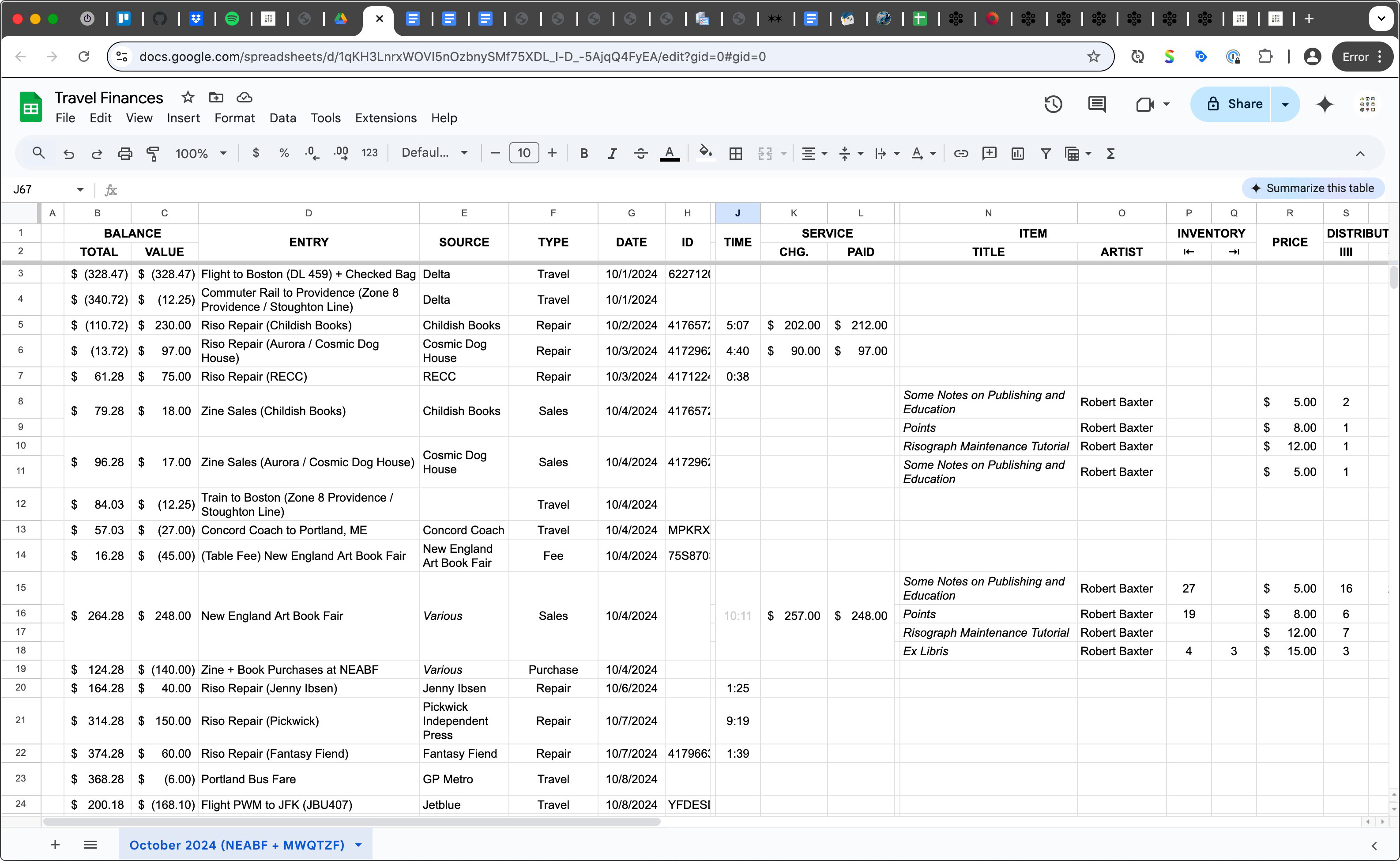
(C) The numbers + logistics for costs and income.

NOTES AND IDEAS
Some miscellany here—I note-take pretty constantly, especially when in conversation with other people—so the following are reflections on reading my notes of some of the chats and experiences that stuck with me.
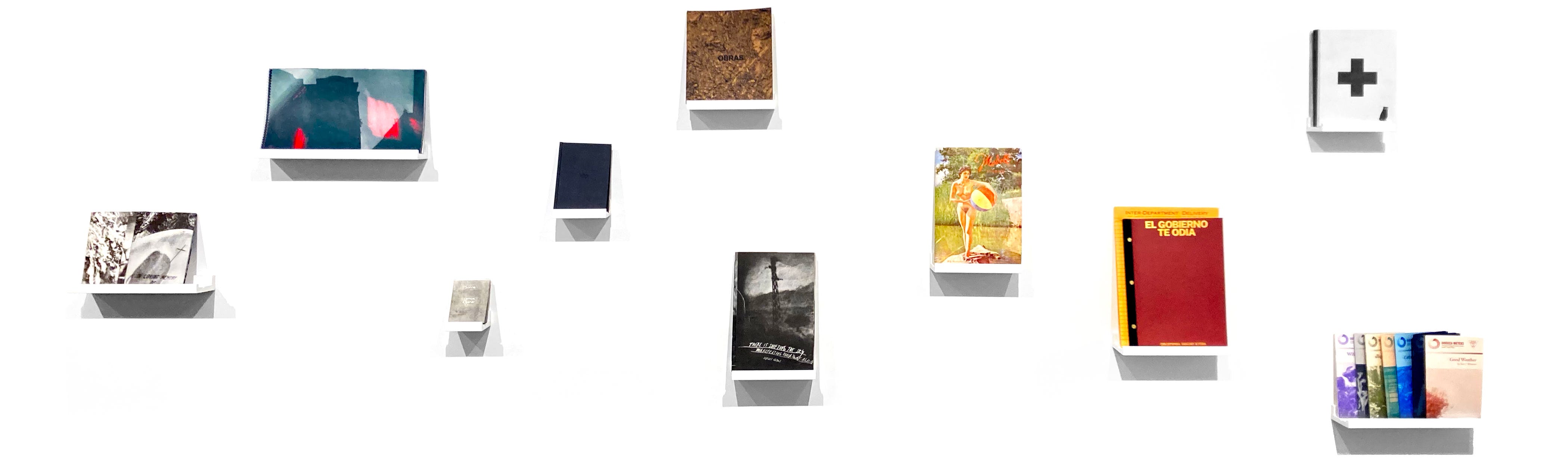
I attended a panel for a really beautiful riso photobook show at the Penumbra Foundation (with Linday Buchman, Kevin Kunstadt, and Dolly Meieran)—I think the large body of the audience wasn’t familiar with riso. The conversation turned, as it often does, to labor and cost for riso printing, specifically in the context of artists book on display there. I jotted down something that Leandro Villaro (curator of the show) said that struck me: “The thing that each of these books have in common is that they each hold a labor that isn’t seen in their prices—in fact, all books do, but these more so than most.” It’s true, and I think it’s kind of a beautiful thing—there is a bit of a trade that happens in this medium—the artist trades their own labor for both the beauty of the format and as a gift for the experience of their readers—to engage with these strange objects. It isn’t to say we don’t make money or even profit off our work (see Genderfail’s Profit for Survival), just that we give a little more into it than we ask in return.
One of my favorite things to print with riso is neutral tones using a mixture of vibrant inks. At some point (probably looking at all the beautiful process work in Penumbra) I had the idea of doing a conceptual materials book, where I use different ink combinations and paper tones to try and produce identical fields of grey tone (a la Albers and Seurat and those other types).
At the NEABF, someone looked at my work and then told me about a critique they used to receive when they were a student: "You really want people to read, don't you?" A fair assessment for my work as well, to be sure.
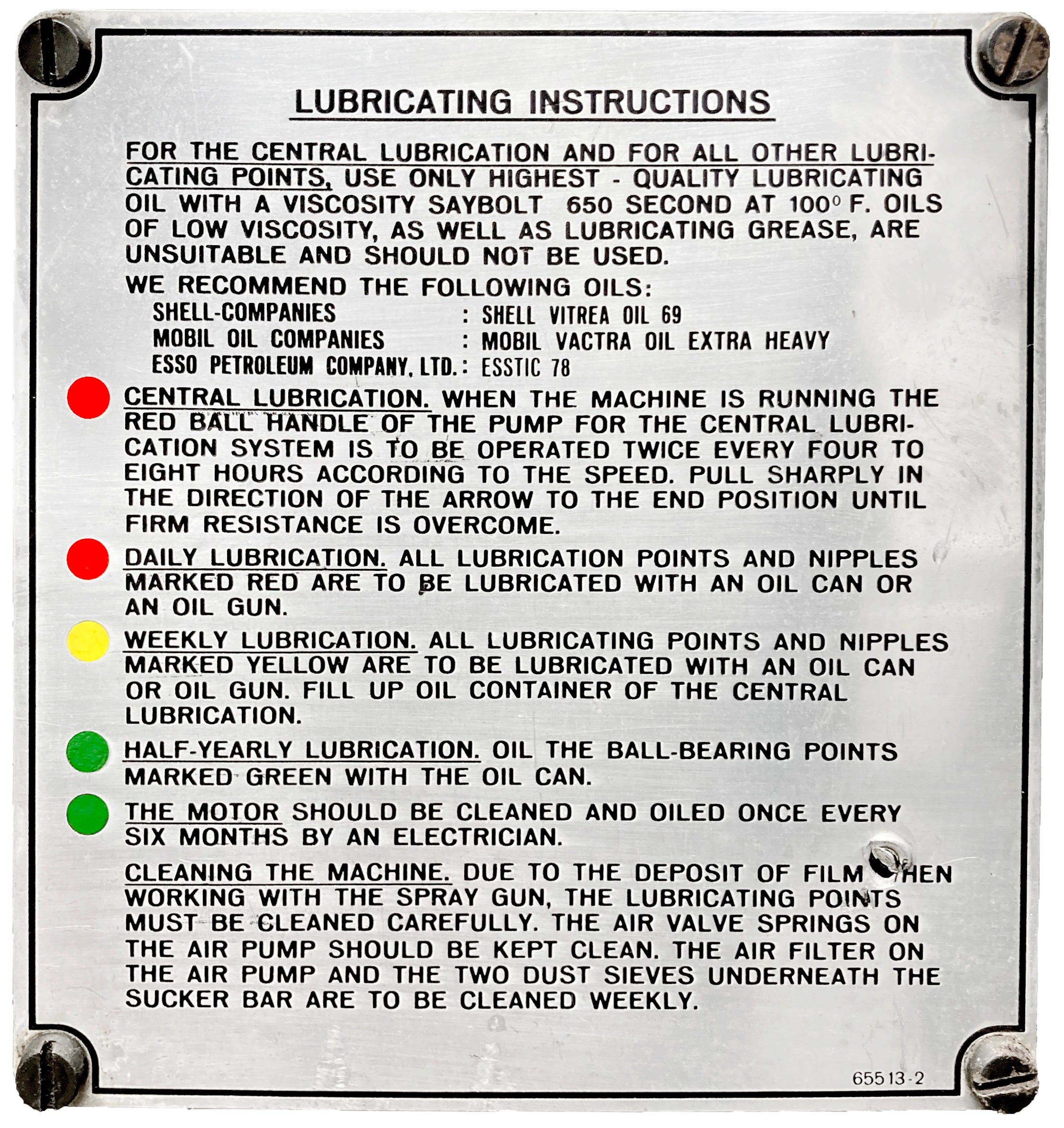
I got a chance to see a Heidelberg windmill in full swing while in Portland, ME—in the studio of Nicole Manganelli (Radical Emprints). It’s always been on my list of ideal printshop equipment, but I haven’t seen one running in person before! The operator is interacting with it really directly, leaning over it, pulling levers, checking print quality, making adjustments—very much a part of the timing themselves. We spent a little time correcting an issue with the air feed and sheet feathering, which was also my first time really working on any letterpress equipment as a technician.
I happened to be in Brooklyn during a small press picnic hosted by Hannah at Small Editions where I met Brian Ellis and his music score zines. We talked about an old project idea of mine (which now might be a new collaboration when we find the time) on writing a sort of serial glossary of notation systems. These could be for music, dance, information, history, etc. Each issue would include at least 3 systems, including one contemporary one, and one ancient—with information on the history of the system, how the read it, and examples. Brian recommended Guidonian hand (a medieval mnemonic system for sight reading) as a starter.
In the maintenance workshop I ran in Minneapolis, almost every single attendee had gotten a machine within the last 2 years. It makes sense for it to skew that way (there were definitely some more established riso types in town who couldn't make it), but it was still surprising! It echoes what I've seen in other cities: riso is on the rise, especially as the older machines become more affordable.
The MQTZF was one of my favorite fairs last year, but it was not without its drama—which was strange and uncomfortable, especially for my friends who were organizing it. One of the vendors tried to take the ideological stance that all zines should be free—and specifically denounced another vendor who was selling a zine they thought was too expensive (I don't think they realized it was a fundraising edition for a local queer org.). It wasn't a very well-reasoned take (and had as it's target some of the coolest and most beloved organizers in the room), but it brought into conversation a few things:
“The question of what does anticapitalism look like for artists, specifically in DIY art communities? One approach is that in DIY art spaces we should be avoiding exchange of money as much as possible—stealing copies, trades, etc. Another is that pricing things to make creative practice sustainable is also an anticapitalist approach. I bet most people do some of both”
(This is from India Johnson—I sent a draft of trying to document/recollect this conflict—and she sent back this much better version of it—so I want to include it in full.)
The changing meaning and sort flimsy umbrella of the word "zine." Because yes, a large aspect of zine culture, at least from the punk side (which is of course not the only history of zines) is fully in ephemerality and cheapness, and stealing from the institution. But it also historically encompasses community news, perdiodicals, event documentation, perzines, fanzines, etc. etc. etc.—and now it spans the gamut up to and overlapping artists books.
I’m trying to reconcile more of this chat into useful observations, but maybe I can only give fragments of the values that came up in conversation:
Artists should be able to make a living off of the work that they make—for many of us, independent publishing is part of that work. For some of us, our publishing is a primary source of income.
At any given fair you will find, side-by-side, objects of identical form, and representing more or less a similar amount of labor, but priced wildly differently. This is a small/micro press thing in particular because we sort of have to answer that question of cost ourselves—whereas in the larger publishing world the governing doctrine of capitalism means that the prices are limited, bracketed, and form dependent (all trade paperbacks are priced within a rather small bracket, as are all hardcover novels, etc.). There is a market-regulated definition of media that we are operating beneath.
Information should be more accessible, and often that is a matter of financial accessibility—zines can and do play a major role in gathering information and sharing it freely. This is not separate from the question of their cost to produce, but part of it.
No ethical consumption under capitalism, etc. but redistributing funds amongst your shared community of independent publishers is certainly a better way than many others.
“It’s increasingly more difficult to steal copies, which complicates things. Copy and print pricing is not completely within artists’ control—it’s related to copier service contracts” (India).
There are of course systemic failures all around, but for me one I keep coming up against is that the info zines I make, are in response to the monetization of information by schools and large publishers. As a result I have a personal conflict between paying myself and getting useful info out into the world. (For this I’m usually looking to the work of Temporary Services and how they handle multiple forms of distribution.)
While on a long drive (by coastal standards, not by midwest standards) to Milwaukee to pickup a GR, Aiden Bettine (of Late Night Copies) and I had a chat about a book we want to write together on "post-obsolescence." It's a practice we've both become accustomed to, and play particular roles in—salvaging equipment and keeping it running beyond its end of life (most often detritus from the corporate churn which is made useful again for artists and community work). Some topics from our outline:
Why this work and why this works.
Buyers guide (where to find equipment, how to look, where to find parts, freight + shipping) specifically for photocopiers and risographs.
The tactics of planned obsolescence (proprietary parts, short lifespan of components, supply chain dependency, obscure documentation).
The tactics of post-obsolescence (mending and repair, generic replacements, parts manufacture, community resource sharing, self-taught technicians).
Lying to computers + tricking control systems.
Relationship to consumption and other movements + waste reduction + right to repair.
The labor and commitment of maintenance (what to prepare yourself for).
Projects in post obsolescence from other artists.
Stealing from the institutions (or re-appropriating their purchasing power, if you prefer).
When we got there, we snagged a (not at-the-time working machine) and 5 or so drums of unknown status. After trudging it upstairs we spent an hour of so evaluating it in the lobby—we re-calibrated some bits and replaced some others—and got test prints coming through. As of this posting, all but one of the drums are running happily and the machine has been installed in a new community print space (Workshop for Independent Publishing in Minneapolis). Post-obsolescence!.
I have a small note from later in the week with India (who is the other half of Late Night Copies): "An MFA for real people." [On longer form teaching + curricula in community print spaces.] India teaches both long and short form bookbinding and publishing classes in a number of spaces across Minneapolis, both schools and arts orgs. We were chatting about our shared dream of people having access to “higher education” outside of the institutions—and the sort of missing curricula (both practical and conceptual) that could exist beyond the ubiquitous introductory classes in art spaces. We long for seminars, and lectures, and cohort study, and critique!
I think we both look to the IPRC’s Portfolio Program as inspiration (and I recently learned more about the cool work of Alex Kostiw at Spudnik). I used to do a lot of research on this but the past examples I was focusing on were for design education, so I’m finding new examples of non-institutional teaching in art + publishing all the time now.
The Queer Zine Archive Project presented at MQTZF on their shared ethos of collecting and publishing (which included a lot of good queer history, esp. with regards to the suppression of queer periodicals from being distributed by the USPS and the court case “One, Inc. v. Olesen”). Fragments from this:
Milo Miller described making zines: “I own the whole stream of production”—and when it is published there is an immediate loss of control is it enters the public hands.
In small press there is a “built in scale of economy” (I don’t have further notes on this, but I want to say it was in relation to how the production methods and costs associated with making a publication directly affect the size and scope of its distribution—I connected it internally to the value of providing and sharing equipment.)
When describing what would happen if the archive were lost in a fire: “zines are, by their nature, a distributed backup” (Milo).
Print keeps circulating—this is not so for the internet, which prioritizes immediacy and more and more is devaluing searching and archiving. The technology builds on itself, but the navigation has not.
Zach Frazier of Astringent Press also spoke on their press as “a reaction to the economic concern of artists”—a means of redistributing the resources they have access to (through the university they teach at) to the queer art community. Here’s bits I snagged from that.
Publishing as “returning my labor to the public.” (Zach)
The documentation of Astringent’s publications is always done through video of someone flipping through the book—the hands act as a signifier of the act of sharing.
The (familiar to me) process of having to interrogate the value system inherited from a design education.
Aiden also talked a little bit about operating on an “economy of favors”—as we went from here to there in Minneapolis, supporting friends in their endeavors. It was an offhand way of participating in and observing the flow of goodwill in that community, that I liked particularly as a turn of phrase and way of thinking. At first I got hung up on the word economy, for it implies an exchange, but more often than not that the only exchange was in giving into the ether and receiving in turn that the ether was bettered.
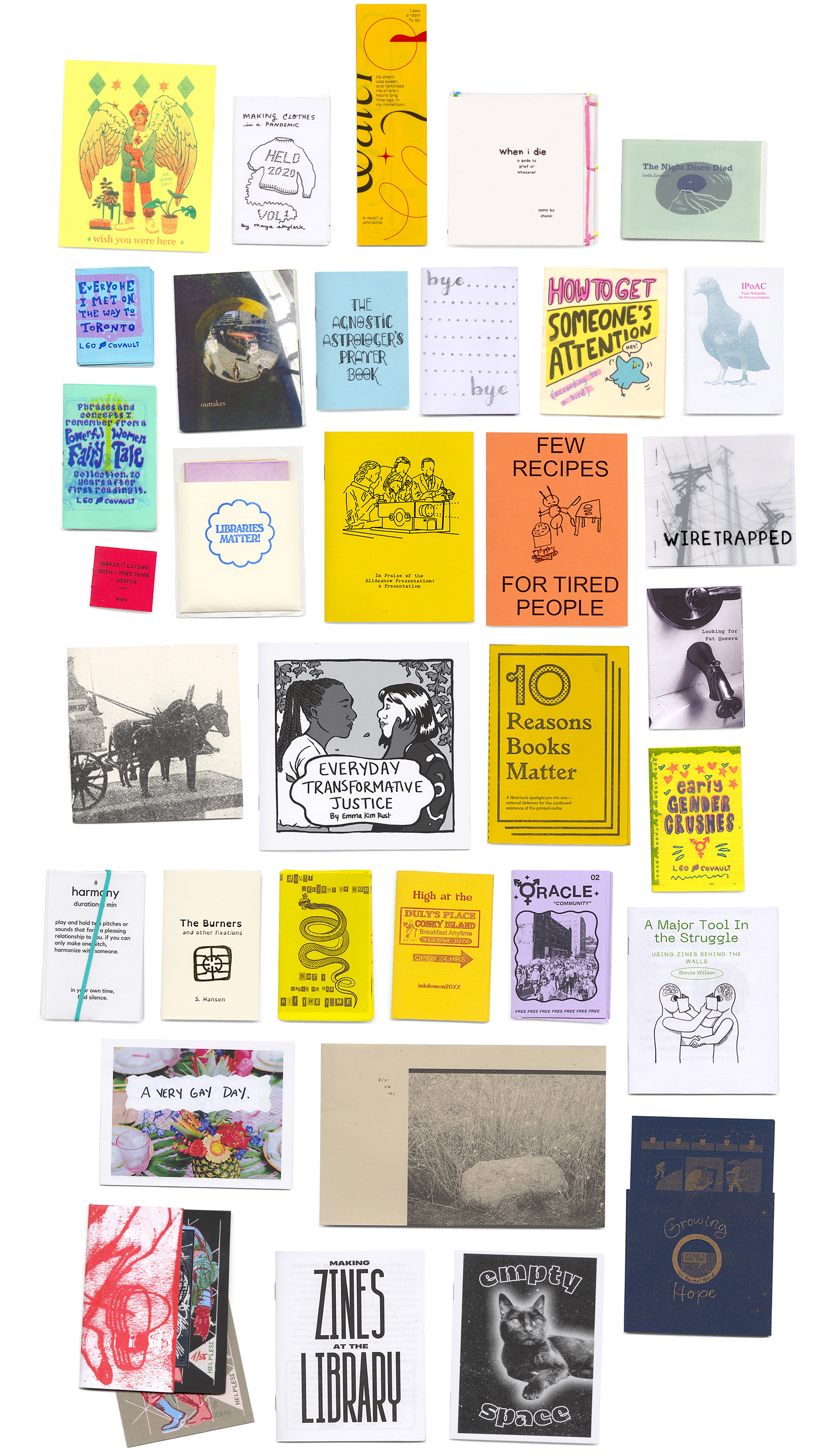
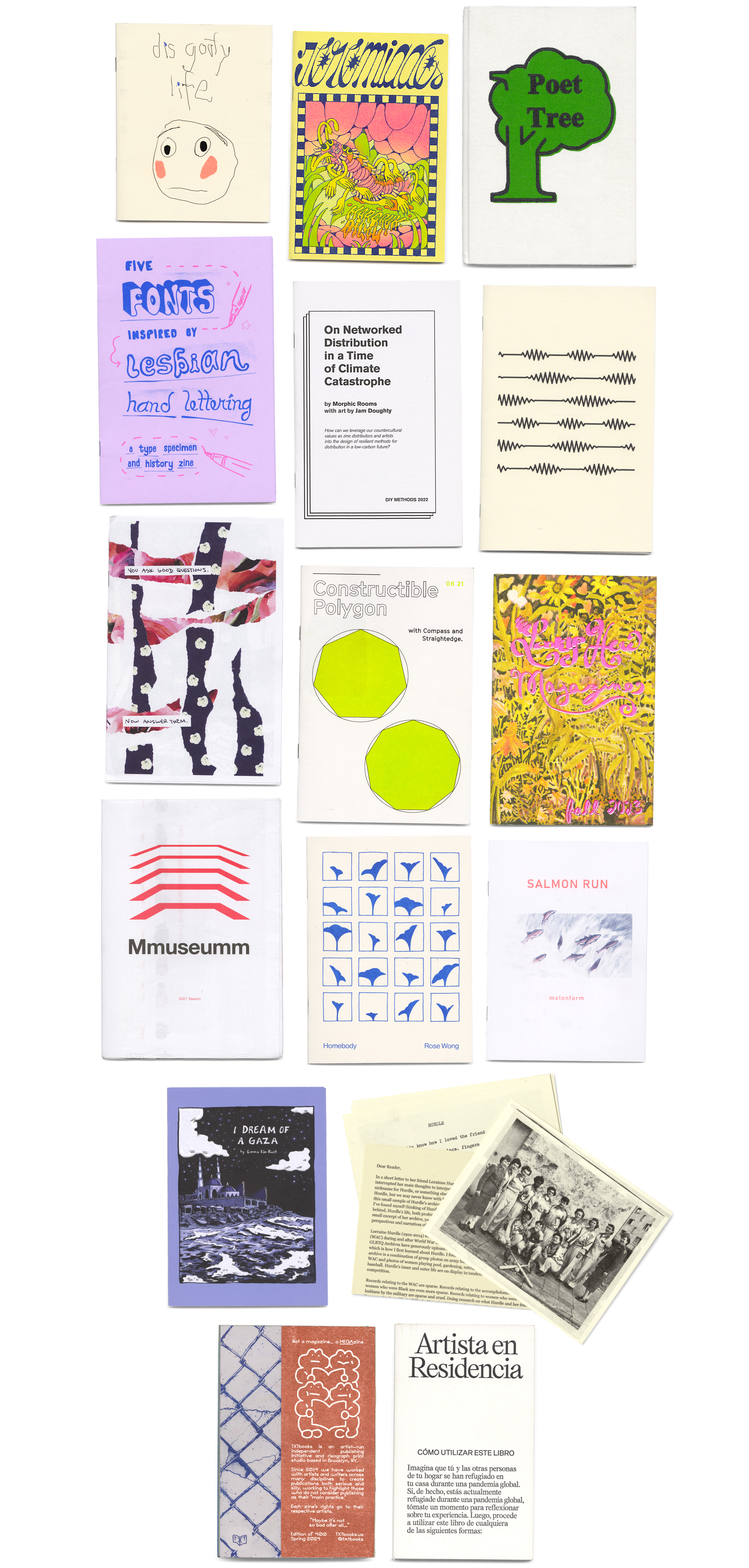
A (SMALL) SELECTION
I picked up so many zines and books on this trip. I wanted to include a smattering of them—but this is only a small portion of them. The only rhyme/reason here is that these are the things in the box I shipped myself (so they were all fairly small and flat). Many things left out.
THE BREAKDOWN
This part is excessively boring, unless you have a particular interest in financial transparency (or how the books sort of balance for this kind of work)—the fun stuff is the sections that preceded it.
On this trip I visited 9 cities (with a further 2 as travel intermissions).
I was gone for almost exactly 31 days (down to the hour).
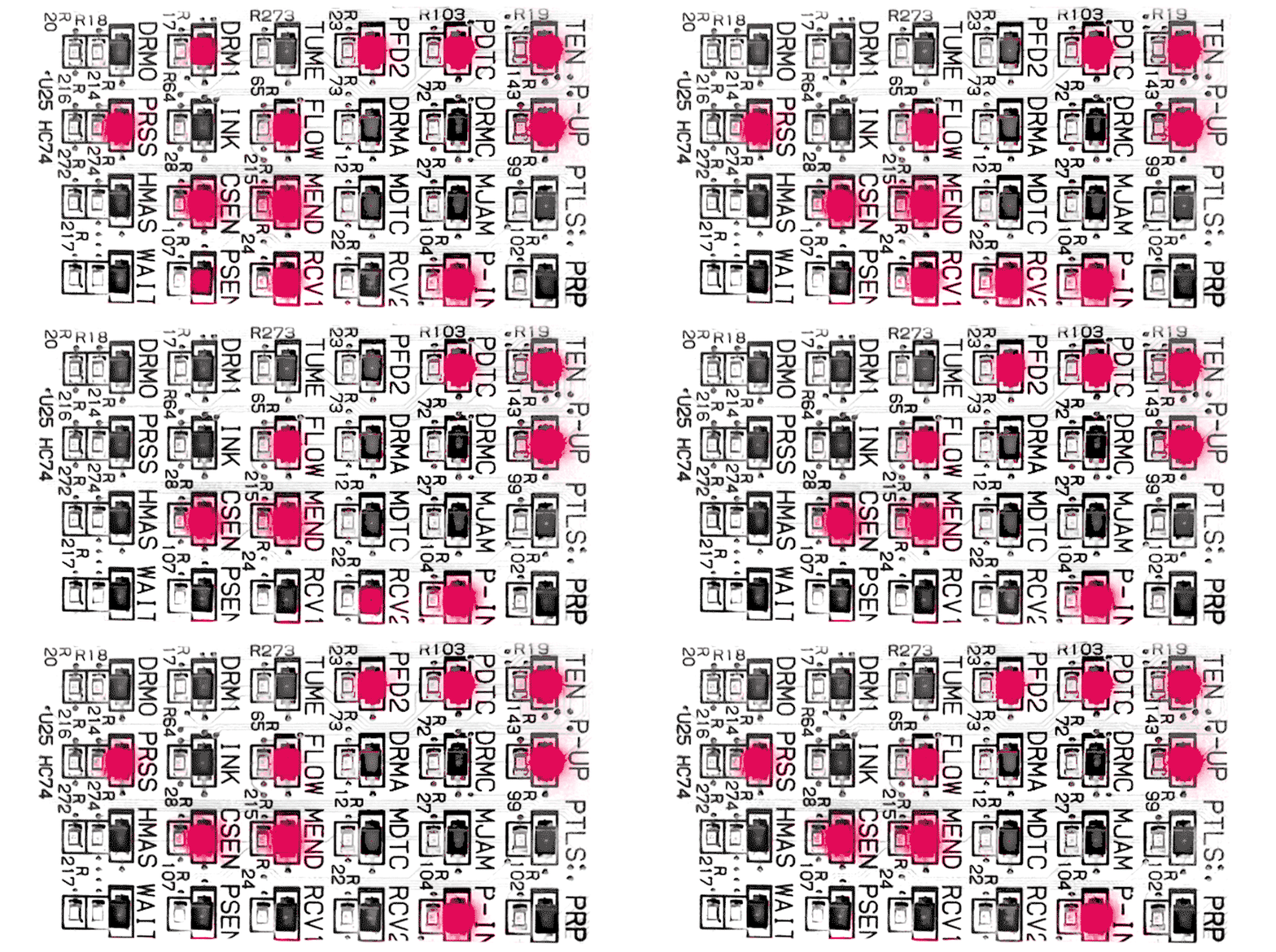
In this time I worked on 24 risos (including 2 of which I helped move), and 14 drums (plus an additional 3 machines and 1 drum remotely). All but one of the repairs were successful, the last has been a long term patient in Brooklyn, who we are slowly tracking down replacement parts for.
This constituted roughly 105 hrs total labor, about 85% of which was paid (the rest was a mixture of trade for room and board or zines, or favors and volunteer work here and there).
For this, after all invoices come in, I will be paid about $2482. This means my rough hourly rate (for the repairs that were charged) for this trip was: $27.95/hr. (I charge by task, not time, so that I don’t penalize anyone for going slow, and have time to teach—but I like calculating an hourly to understand my cost of labor.)
While in Minneapolis I taught two workshops, an introduction to riso maintenance and a drum cleaning group session—tuition was sliding scale for both, $30–60. The maintenance session was well attended (I think 6 presses were represented), and I made $270 from that, the drum cleaning session was much smaller, but brought in $90.
I also worked 15 hrs in just production support for friends on their upcoming projects.
I tabled at two fairs, the New England Art Book Fair and the Midwest Queer and Trans Zine Fest—at these I sold 54 zines and traded 4 others. Outside of fairs I sold another 5 books and gave away or traded another 12. Of the stock I brought (which was only 4 titles, the least variety I've ever tabled with), I came home with 3 copies of Points, everything else left along the way.
At the NEABF I sold 32 zines and made $248 in sales. The table fee was $45. The show was 8 hours total across two days, and during this time 105 people visited my table (I keep a count of people who either touch my books or make conversation, which I can then compare to the counter for the event, to see how well my work does with different audiences). For this fair I sold things at fixed cost, the most expensive thing on the table was $15 (a complicated hand sewn Ex Libris), the cheapest was $5 (the stapled Some Notes on Publishing and Education—which finally debuted with its new cover!).
At MQTZF I sold 22 zines and made $264 in sales. The table fee was $5. This was also a two day fair, though I only had enough stock for one day—during the 5 hours I was vending (I sold out an hour early) 71 people visited the table. For this fair I sold everything at the same sliding scale of $5–15. This was another point of confirmation that I tend to do better financially when I sell work at a sliding scale—the equivalent fixed rate cost for those same books would have been $173; on average people paid $12 per zine.
Outside of fairs, I made $35 from the sale of 5 zines to friends. I tend to give away a lot of zines—this trip it was mostly the Risograph Maintenance Tutorial (also the main thing I trade at fairs) because I want to get it into the hands of folks running these strange little machines.
I took 5 planes, 7 trains, 1 coach, and (to my best guess) 20 rides on the MTA and 3 city busses. The total travel cost was $1111. Additionally friends ferried me two major legs of the trip (and drove me between Portland ME, and Brunswick where I was staying).
I exclusively stayed with friends (old and new) and family, so paid no housing costs this trip (besides my overpriced, empty, Seattle apartment). I didn't do a great job tracking other cost of living things this trip, but can say confidently that I ate in about twice as often as I ate out (and helped sous chef where I could). The most I spent on goods was almost certainly in airports, which are horrible. And then NYC, which is not horrible, but is certainly expensive.
My largest expense was almost certainly books and zines, which I estimate I spent ~$615 on. This was probably incredibly foolish of me but I was at two fairs where the majority of the work was new to me—and it was my first time tabling a queer trans zine fest, and everyone there was very cool.
When flying out of Seattle I had to have a carryon for the first time in a while (my box of stock)—I took twice as much stock as usual for the longer trip. (I always check a bag for parts + tools, but it was 45 lbs without that box.) In Milwaukee I had friends ship me a box of zines before my flight back west, as my bag now weighed 70 lbs, even having sold all my stock.
In addition to fairs, I visited some favorite bookstores in NYC: Dashwood Books, Codex, and my first (and last) visit to Printed Matter St. Marks (mostly to visit Eva from Calipso before they closed); as well as Boneshaker in Minneapolis.
INCOME FROM REPAIR WORK ————————————————— 2482
  REPAIR TIME                   104:47
    PAID (NOT TRADE OR VOL.)    88:48
INCOME FROM WORKSHOPS ——————————————————— 360
  TEACHING TIME                 7:45
INCOME FROM SALES ——————————————————————— 547
  TABLING TIME 16:31

  MISC. INDIE LABOR             16:28
  CONTRACT WORK                 49:18


TRAVEL EXPENSES ————————————————————————— (1111)
ZINE + BOOK PURCHASES ——————————————————— (615)
FEES + POSTAGE —————————————————————————— (109)

TOTAL »»»»»»»»»»»»»»»»»»»»»»»»»»»»»»»»»»» 1554
  TOTAL                         178:21
It’s actually a bit lower than this as I haven’t filtered in the cuts that Venmo + PayPal take from sales yet.
Basic conclusions:
Sales at fairs about balanced the cost of books from fairs and table fees (so net zero between those—which again, usually I do a little better than break even, but I bought a lot of stuff).
Alternately, had I bought nothing at fairs, they would have covered the portion of travel that was exclusively to and from the fair.
As it was, travel expenses (including between many non-fair cities) were covered by 45% of repair work income.
In total, across the month I worked 178:21 hours (repairs, printshop support, tabling, documentation, projects, and other independent), making my weekly workload roughly 28:45 (some of this was remote pre-press work, maybe 3–6 hours a week, payment for which is not included in the total above).
Next Up
Well, this post took quite some time—so much so that I have since gone back to the midwest and returned again! I was summoned (with many of the other friends above) to a gathering of riso community organizers hosted by bearbear. We took really good documentation of the event, so I might share bits and pieces from that in the near future.
In the meantime though, if you’re in the region (Minneapolis), Workshop for Independent Publishing is opening this weekend! Their first Open Copy (public printing hours) is on Saturday, February 8 from 11AM to 5PM.
I’ll be tabling at the Print, Copy, Paste zine fest in the Jacob Lawrence gallery in Seattle, on Friday, February 21 from 2–8PM. As soon, as soon as I have stuff printed to bring to it (I am currently fully out of stock).
I suspect the next few posts in here will be more technical—I have some processes I want to document:
An InDesign workflow for riso prepress (and probably some musings on switching to Affinity Publisher at some point—a plan for later this year).
A basic paper feed training and troubleshooting guide for the friction feed in risographs (something all operators should know and be able to correct).
Some notes on the updates that George Wietor and I have been making to the (not-as-of-yet-public) new version of stencil.wiki—and the process of working on a wiki.
Holy smokes this is a ton of work. I hope your collaborators value the way in which you give them so much of your experience and knowledge.